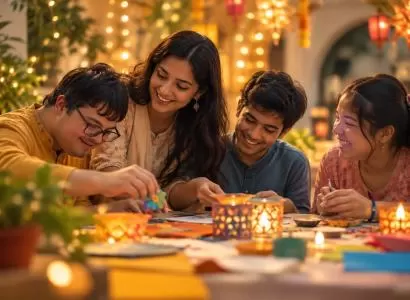
As we are moving into the fast-paced digital world campaigning about inclusion everywhere, many of us have lost something very special and crucial: the way we communicate. Most of our conversations nowadays are just limited through online platforms, sending message threads, voice notes or having blurred video calls. We are losing touch of direct eye contact, a genuine smile, movements of hands and the facial expression of emotions that used to knit us together. These small changes connect us with others including people with hearing impairment and other communication difficulties in day to day conversations.Sign language can help transform life, not if we treat it as a symbolic gesture but as an everyday language of dignity, connection and inclusion.
The World Health Organization (WHO) estimates approximately 63 million people in India suffer from significant hearing impairment, a prevalence of 6.3% of the population and it has also estimated 2.5 billion people to be affected by 2050. This includes children, adults and elderly population.
Despite having a well strutured Indian Sign Language (ISL) , how far it has reached the corners of the country is still doubtful and the availability of trained sign language interpreters and trainers are just a handful. This means that children with hearing impairment often sit in classrooms not following the lessons which results in disconnecting from peers and gradually being excluded from both learning and belonging.
The challenges for individuals with hearing impairment extends beyond schools. Families do not know how to respond to their family members with hearing impairment. They see it as only a medical problem rather than seeing it as a communication difference. With lack of guidance and community awareness, these special populations are excluded from social gatherings, silencing them further.The lack of communication affects not just their academic performance but also their self-esteem and mental health.
The Rights of Persons with Disabilities Act (2016) recognizes communication as basic rights and the National Education Policy (2020) emphasizes inclusive education addressing the needs of every Child with Special Needs. The Accessible India Campaign also emphasizes that all television programs should have sign language interpretation.
But the real question is, are these initiatives reaching everyone? In reality only a handful of schools have that too in urban localities that have sign language in their syllabus. In villages, the implementation remains almost absent, leaving children and their families with promises only on papers but silence in reality.
Campaigns are important to increase awareness and sometimes they can touch the hearts of the audience. The “Sign With Fingers, Big & Small” campaign by Cadbury (UK) in partnership with the National Deaf Children’s Society is an example. It encouraged the public to learn British Sign Language (BSL) through short, everyday lesson prompts like “Fancy a cuppa?”, highlighting how deaf individuals missed out in “shared moments”. Yet such impactful campaigns remain special editions, a brief shining moment. Its transient nature emphasizes the distinction between normalcy and awareness.
If inclusion is to be real and not rhetorical, India must treat sign language not as a “special” tool but as part of its everyday communication landscape. This requires both systemic reform and cultural transformation.
As the Government emphasizes a three language policy, let sign language be one among them, making every child of the next generation be aware that the Indian Sign Language building signs are normal and not exceptions. Teachers, too, must receive sign training as part of their professional development, ensuring that when a child with hearing impairment walks into a classroom, they are not seen as an exception but as part of the norm. Early normalization also helps society as a whole because sign literacy will be used in the workplace by future government officials, engineers, doctors, and shopkeepers.
Consider banks, government buildings, and train stations where employees are taught basic ISL greetings and directions. Imagine if sign interpreters are regularly used by TV news programs, not just on special occasions. People with hearing impairments are no longer viewed as "special guests" in society, but rather as legitimate participants in its everyday rhythm thanks to this normalization Rather waiting for the Top to Bottom approach to be successful, let's start the change from our homes, in our local communities.
Let's talk more in signs along with verbal communication and take a moment to understand the gesture of the elderly parent and children with hearing impairment including them in our day to day conversations. Communication obstacles in the family start to disappear when parents learn basic signs to communicate with their kids or when grandkids learn signs to communicate with their grandparents.Sign language is a solution to everyday dignity of people with hearing impairment rather than academic inclusion, as a way to express their preferences, or just laugh at a family joke.
To reflect on this more personally: when we ignore sign language, we silence people; when we embrace it, we amplify not only their voices but also our shared humanity. The choice before us is whether we want inclusion to remain a campaign slogan or to become the everyday fabric of India’s conversations.